Basic concept
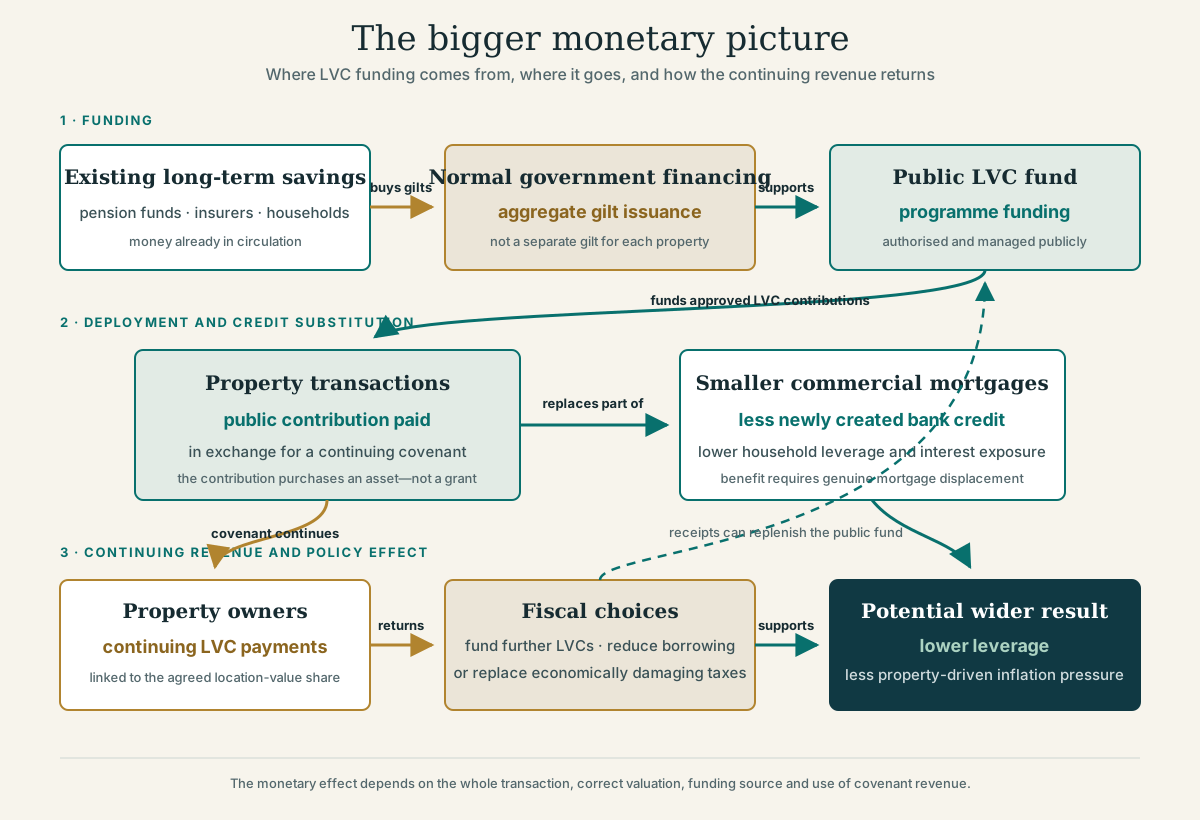
Location Value Covenants could have an important monetary-policy merit in addition to helping individual households. Properly designed, an LVC can replace part of a conventional mortgage that would otherwise be created by a commercial bank.
Commercial banks create new deposits when they make loans. Mortgage expansion can therefore increase broad money, household leverage and the amount of credit competing for a limited supply of property. The Bank of England explains that the majority of money is created when commercial banks extend loans.
An LVC offers a different route. Government can finance the public contribution through normal gilt issuance placed with pension funds, insurers, households and other investors using existing savings. If every pound of LVC funding replaces a pound of mortgage lending that would otherwise have been created, existing savings take the place of new bank credit.
The crucial distinction
Gilt issuance is not automatically deflationary. Investors first pay government for the gilts, but government then pays the LVC contribution into the property transaction. The withdrawal and expenditure broadly offset one another.
The monetary advantage arises from the mortgage credit displaced, not simply from issuing government debt.
The appropriate policy test is:
Every £1 of new LVC funding should replace at least £1 of conventional mortgage credit that would otherwise have been created.
Worked example
A household purchases a £300,000 property with a £60,000 deposit.
| Source of purchase funds | Conventional mortgage | LVC structure |
|---|---|---|
| Existing household deposit | £60,000 | £60,000 |
| New commercial-bank mortgage | £240,000 | £120,000 |
| Government LVC contribution | — | £120,000 |
| Total purchasing funds | £300,000 | £300,000 |
Under the conventional transaction, the purchaser funds the full £300,000 using a £60,000 deposit and a £240,000 mortgage.
Under the LVC transaction, the purchaser provides £180,000 using the same deposit and a £120,000 mortgage. The public LVC fund provides the remaining £120,000 to the vendor in exchange for a continuing covenant attached to the property. The vendor therefore still receives the full £300,000.
The purchaser has not received an unrequited £120,000 subsidy. The £120,000 contribution is matched by a continuing £500 monthly covenant payment, initially equivalent to 5% a year and subsequently adjusted in line with local land values. Because successive owners must assume that payment, the market value of the purchaser’s interest in the property is approximately £120,000 lower than the value of the property without the covenant.
The initial LVC is not calculated from a precise valuation of the land or from a specified share of the property’s location value. The agreed contribution determines the initial payment; local land values provide the index by which that payment changes afterwards.
If the public contribution is financed from genuine existing savings, the transaction is completed with £120,000 less newly created commercial-bank mortgage credit while the public fund acquires a continuing revenue-producing asset.
How an LVC works
The beneficiaries
- Homeowner — why would I do this? I replace part of a large interest-bearing mortgage with a lower continuing covenant payment. This reduces my monthly costs and exposure to mortgage rates, negative equity and repossession. In exchange, the covenant reduces the future sale price because the next owner must assume the same obligation.
- Government: It acquires a continuing public revenue asset while replacing part of the bank-created mortgage credit that would otherwise finance the purchase. This can reduce household leverage and improve monetary and financial resilience.
- Bank: It provides a smaller, lower loan-to-value mortgage with less default and negative-equity risk. It retains a lending and customer-service role, although it earns interest on a smaller principal.
The homeowner’s benefit is not free public money. The public contribution is exchanged for a continuing payment attached to the property. The homeowner chooses greater affordability and lower financial risk today while accepting the corresponding reduction in the property’s future sale price.
Effects of an LVC
What happens to the public money
The Treasury does not issue a separate gilt for each home. Parliament would authorise an LVC programme, and its aggregate cash requirement would form part of normal government financing. A public LVC fund would pay the approved contribution through the purchaser’s bank or conveyancer when the covenant was registered.
Government receives a continuing public asset in exchange: the right to collect the property’s LVC payment from successive owners. In the early years, new contributions would exceed covenant receipts. As the covenanted property base grew, its receipts could finance an increasing share of new LVCs, administration and other public purposes.
How the covenant asset is valued
In the original example, the initial covenant payment is calculated directly from the agreed public contribution:
Initial annual payment = LVC contribution × initial covenant rate
For a £120,000 contribution at an initial rate of 5%:
£120,000 × 0.05 = £6,000 a year
This is equivalent to £500 per month. The payment is subsequently adjusted in line with local land values.
Government receives a legally enforceable, continuing revenue-producing asset. Its economic value can be estimated as the discounted value of its expected future net payments:
LVC asset value = Σ [expected net payment in year t ÷ (1 + r)^t]
For a payment expected to continue indefinitely and grow at a constant rate, this can be simplified to:
LVC asset value = P ÷ (r − g)
where:
- P is the expected net covenant payment in the first year;
- r is the discount rate, including financing cost and risk; and
- g is the expected long-term growth rate of covenant payments.
Using an illustrative 5% discount rate and assuming no real payment growth:
£6,000 ÷ 0.05 = £120,000
This demonstrates how the continuing payment can support the initial £120,000 contribution. It does not require a separate calculation of the building’s value, the land’s precise value or the attributes of the individual plot.
In practice, the economic valuation would allow for administration, arrears, collection costs, financing costs and uncertainty in future payments. The initial covenant rate would need to be set prudently so that the expected net value of the public asset supports the contribution made.
The continuing payment
The covenant payment withdraws disposable income from the property owner in a similar way to a tax payment. It is most counter-inflationary when receipts are used to reduce borrowing, retire debt or build the LVC fund rather than being immediately added to unrelated expenditure.
If all receipts are immediately spent or used for broad tax reductions, much of that demand restraint is returned to the economy. The fiscal use of covenant revenue therefore matters.
How covenant revenue is used
Continuing LVC payments initially reduce private disposable income. Whether this restrains aggregate demand depends on the government's overall fiscal response. If the revenue finances additional spending or immediate tax reductions, the short-term demand effect may be partly or wholly offset. If it reduces borrowing or is accumulated during inflationary periods, more of the restraint remains.
This produces two distinct policy opportunities:
- Short-run demand management. During periods of excessive inflation, covenant revenue could be used to reduce government borrowing or accumulated temporarily in a stabilisation fund. This would preserve more of the immediate restraint on aggregate demand.
- Long-run structural reform. Covenant revenue could replace taxes that penalise employment, profits, investment and productive activity. Such tax substitution may not reduce aggregate demand immediately, but it could expand productive capacity, improve economic efficiency and reduce inflationary pressure over time.
The appropriate use of covenant revenue could therefore vary with economic conditions. During an inflationary period, the priority might be demand restraint. As inflation subsides, more of the revenue could be used to replace economically damaging taxes.
Policy effect
Why this strengthens the case for adoption
- Less bank-created mortgage credit: households can purchase with smaller commercial loans.
- Lower household leverage: less principal is exposed to compound interest, refinancing and negative equity.
- Reduced interest-rate transmission: household budgets become less sensitive to changes in mortgage rates.
- A broader public balance sheet: government acquires a continuing revenue asset rather than making an unrequited grant.
- Long-term savings put to productive use: gilts can connect pension and insurance savings with housing-finance reform.
- A gradual transition: conventional mortgages remain available while voluntary adoption expands the covenant system.
- Potential monetary stabilisation: slower mortgage-credit growth can moderate one source of property-driven monetary expansion.
This could appeal simultaneously to households seeking lower-risk finance, governments seeking continuing revenue, and policymakers concerned with excessive leverage and financial instability.
Conditions required for the benefit
The result depends on the LVC being treated as the acquisition of a continuing public covenant asset, not as a grant or buyer subsidy. A monetary-stability programme should require:
- The initial covenant payment to correspond to the amount of the public contribution and the applicable covenant rate.
- The continuing payment to be adjusted using a transparent and independently produced local land-value index.
- The covenant obligation to be clearly registered and disclosed to purchasers, lenders and valuers.
- Market valuations and affordability assessments to reflect both the reduced value of the encumbered property and its continuing payment.
- Each LVC contribution to replace commercial mortgage lending that would otherwise be required to complete the same transaction.
- Gilt funding to be directed primarily to genuine non-bank savings rather than associated monetary financing.
- Initial covenant rates and programme limits to allow prudently for financing, administration, arrears and payment risk.
- Gradual issuance informed by inflation, mortgage-credit growth, housing supply and financial stability.
- Covenant receipts to be retained or used to reduce public borrowing when aggregate demand is excessive.
- Coordination between HM Treasury, the Bank of England, the Prudential Regulation Authority, the relevant valuation bodies and the Debt Management Office.
Risks that must be controlled
An LVC is not equivalent to a grant, subsidised loan or conventional buyer-assistance scheme. A larger public contribution produces a correspondingly larger continuing payment. Because that payment remains attached to the property and passes to successive owners, it reduces the market value of the purchaser’s interest rather than providing equivalent additional net purchasing power with which to bid up the property.
The principal property-market risk is that purchasers, lenders or valuers fail to recognise the full capitalised cost of the covenant. The system must ensure that:
- The public contribution and initial covenant payment are disclosed clearly;
- The covenant is registered against the property;
- Affordability assessments include both mortgage and covenant payments;
- Valuations compare the property with and without the continuing obligation; and
- Resale prices are allowed to reflect the covenant assumed by the next owner.
This does not require the building and land to be valued separately or the precise attributes of the individual plot to be investigated. The initial contribution determines the initial covenant payment. A transparent local land-value index determines how that payment changes over time.
Lower combined housing payments may leave households with more disposable income, which could increase consumption elsewhere in the economy. Additional gilt issuance may also affect government borrowing costs and wider interest rates. These macroeconomic effects should be assessed against the larger mortgage and greater credit creation that the LVC replaces.
A defensible monetary-policy claim
Location Value Covenants should not be promoted on the assertion that selling gilts itself removes money permanently from circulation. Government expenditure returns the proceeds to the private sector.
The stronger proposition is:
Location Value Covenants can substitute long-term public funding drawn from existing savings for newly created commercial-bank mortgage credit. Properly limited and valued, this can restrain credit and money growth, reduce household leverage and moderate property-driven inflation while creating a continuing public revenue asset.
This makes monetary stability a significant additional merit of LVC adoption—not a guaranteed outcome, but a design opportunity capable of being measured, piloted and independently tested.
Evidence required from a pilot
A pilot should report:
- The amount of LVC funding issued.
- The mortgage lending directly displaced.
- The initial covenant rate and payment attached to each contribution.
- Whether total purchasing capacity increased or mortgage credit was genuinely replaced.
- The difference between comparable encumbered and unencumbered property prices.
- Whether resale prices continue to reflect the capitalised covenant obligation.
- Changes in the relevant local land-value indexes and the resulting payment adjustments.
- Covenant receipts, administration costs, appeals and arrears.
- Effects on household monthly outgoings and disposable income.
- The source of gilt purchasers and the programme’s financing cost.
- The net value of the covenant assets acquired by government.
- The net effect on public borrowing, credit growth and the wider economy.
The Bank of England notes that higher interest rates reduce spending and inflation, while bond purchases designed to lower long-term rates support spending. That illustrates why the LVC’s monetary effect must be judged from the whole transaction rather than from gilt issuance alone. Bank of England: Quantitative easing.
Financial values, rates and tax references restyle the original policy example. They explain the proposed mechanism and are not current financial, tax or legal advice.